
Group Chat is currently in Beta. The feature is functional but under active development.

When to Use Group Chat
- Cross-project questions: “How does the frontend authentication relate to the backend API?”
- Architecture discussions: Get perspectives from agents with different codebase contexts
- Comparative analysis: “Compare the testing approach in these three repositories”
- Knowledge synthesis: Combine expertise from specialized agents
- Cross-machine collaboration: Coordinate agents running on different machines via SSH Remote Execution
How It Works
- Create a Group Chat — Use keyboard shortcut
Opt+Cmd+C/Alt+Ctrl+C, click ”+ New Chat” in the Group Chats section of the sidebar, or use Quick Actions (Cmd+K/Ctrl+K) - Select a moderator — Choose which AI agent (Claude Code, OpenCode, or Codex) will coordinate the conversation
- @mention agents — In your message, @mention any Maestro session (e.g.,
@Frontend,@Backend). Agents are automatically added as participants when mentioned. - Send your question — The moderator receives it first and decides how to proceed
- Moderator coordinates — Routes to relevant agents via @mentions, can make multiple rounds
- Agents respond — Each agent works in their own project context
- Moderator synthesizes — Combines responses into a coherent answer
The Moderator’s Role
The moderator is an AI that controls the conversation flow:- Direct answers: For simple questions, the moderator responds directly
- Delegation: For complex questions, @mentions the appropriate agents
- Follow-up: If agent responses are incomplete, keeps asking until satisfied
- Synthesis: Combines multiple agent perspectives into a final answer
Example Conversation
Remote Agents in Group Chat
Group Chat works seamlessly with SSH Remote Execution. You can mix local and remote agents in the same conversation: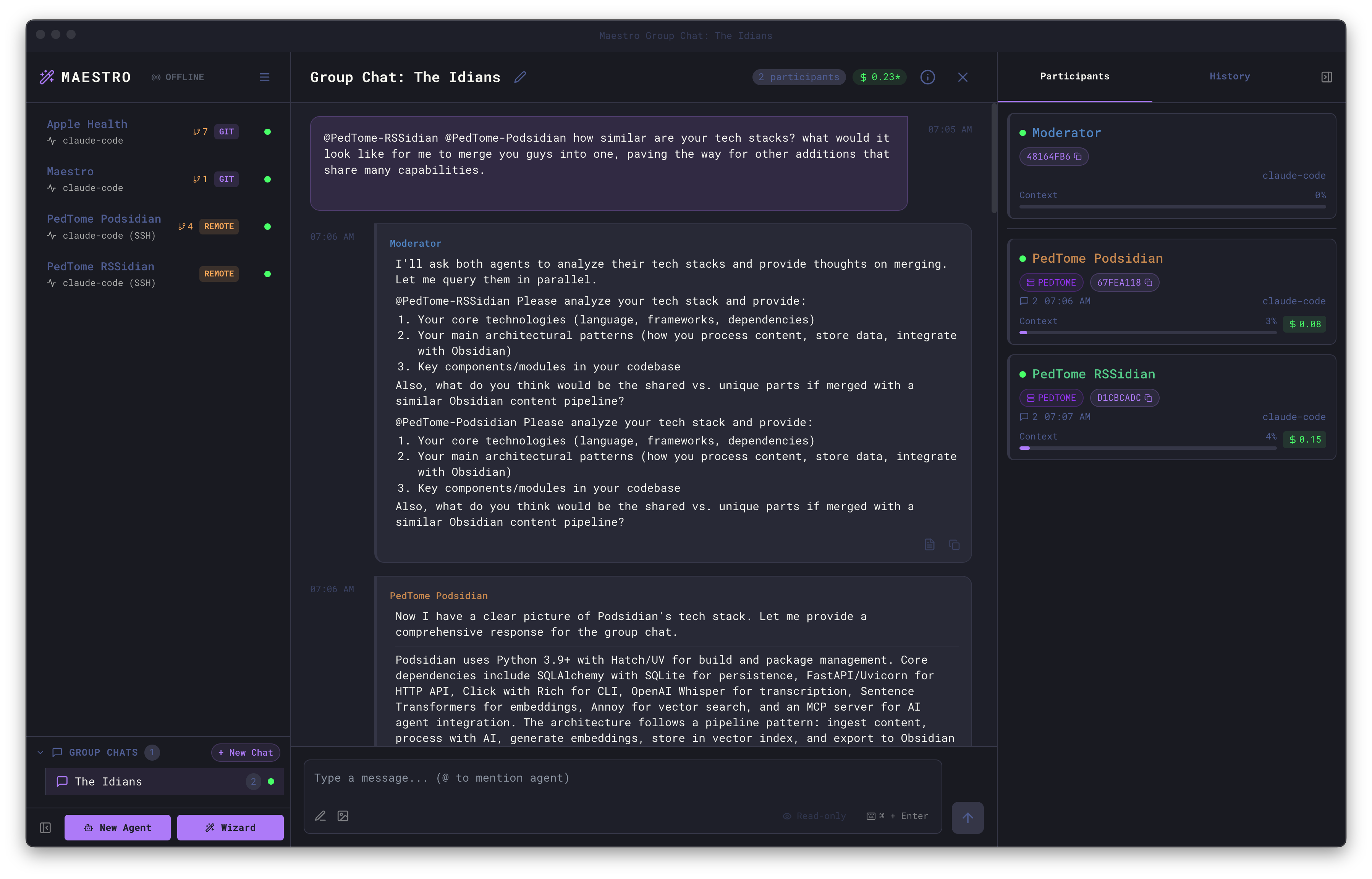
- Local moderator with remote participants
- Remote moderator with local participants
- Any mix of local and remote agents
- Agents spread across multiple SSH hosts
- Compare implementations across development and production environments
- Get perspectives from agents with access to different servers
- Coordinate changes that span multiple machines
- Synthesize information from agents with different tool installations
Tips for Effective Group Chats
- Name agents descriptively — Agent names appear in the chat, so “Frontend-React” is clearer than “Agent1”
- Be specific in questions — The more context you provide, the better the moderator can route
- @mention explicitly — You can direct questions to specific agents: “What does @Backend think?”
- Let the moderator work — It may take multiple rounds for complex questions
- Mix local and remote — Combine agents across machines for maximum coverage
- Hyphenated names for spaces — If your session name has spaces, use hyphens in @mentions (e.g.,
@My-Projectfor “My Project”)
Managing Group Chats
Right-click on a group chat in the sidebar to access the context menu:| Action | Description |
|---|---|
| Edit | Change the moderator agent or customize its settings (CLI args, path, environment variables) |
| Rename | Change the group chat name |
| Delete | Remove the group chat and its conversation history |
Input Features
The Group Chat input supports the same features as direct agent conversations:- Read-only mode — Toggle to prevent agents from modifying files (participants receive the mode flag)
- Image attachments — Attach images to include in your message
- Prompt Composer — Open the full prompt composer with
Cmd+Shift+P/Ctrl+Shift+P - Enter/Cmd+Enter toggle — Switch between send behaviors
- Message queuing — Messages are queued if the moderator or agents are busy